Generic corporate documents.

Photo of two business men viewing a laptop

Investors

LATEST INFORMATION

Explore the latest news for investors and financial journalists.

INVESTORS PRESENTATION

Access Eutelsat's latest investor presentation for a comprehensive overview of our strategy and performance.

SHARE MINICHART

SP Minichart

KEY FIGURES FY2025-26

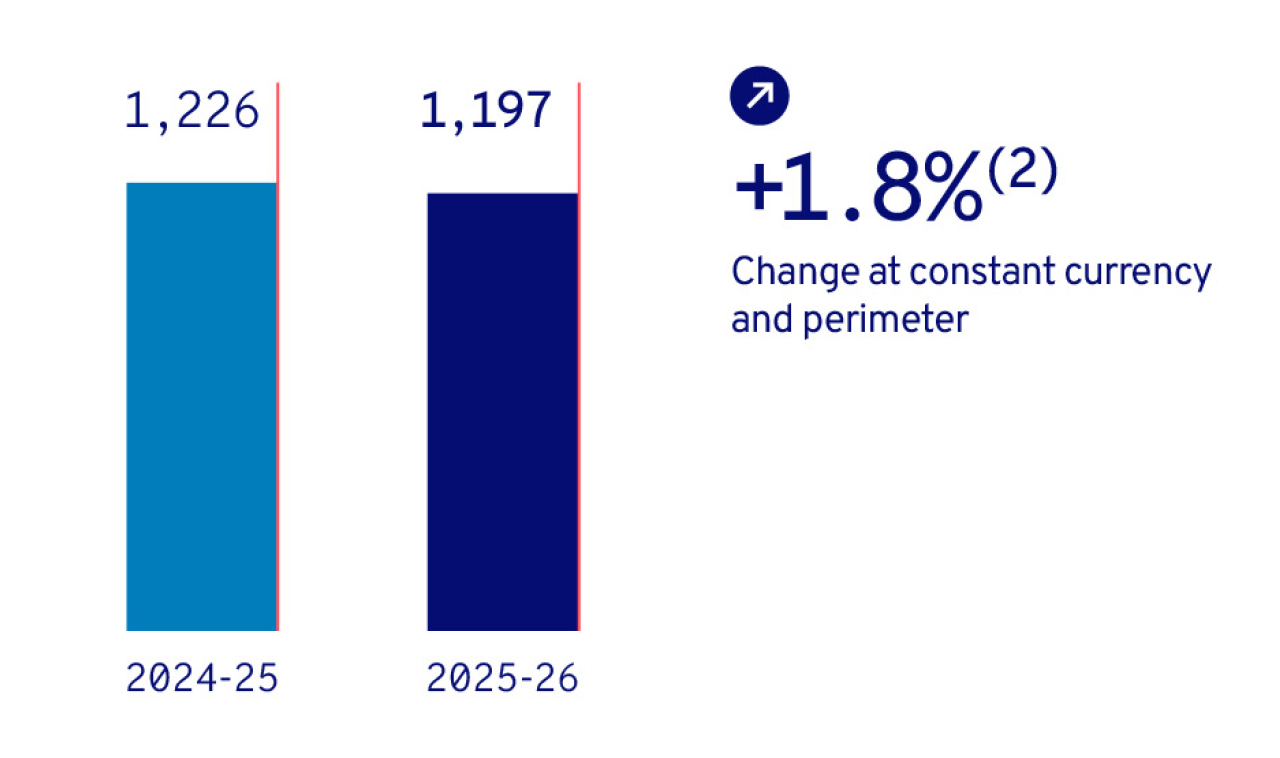
€1.236M
TOTAL REVENUES
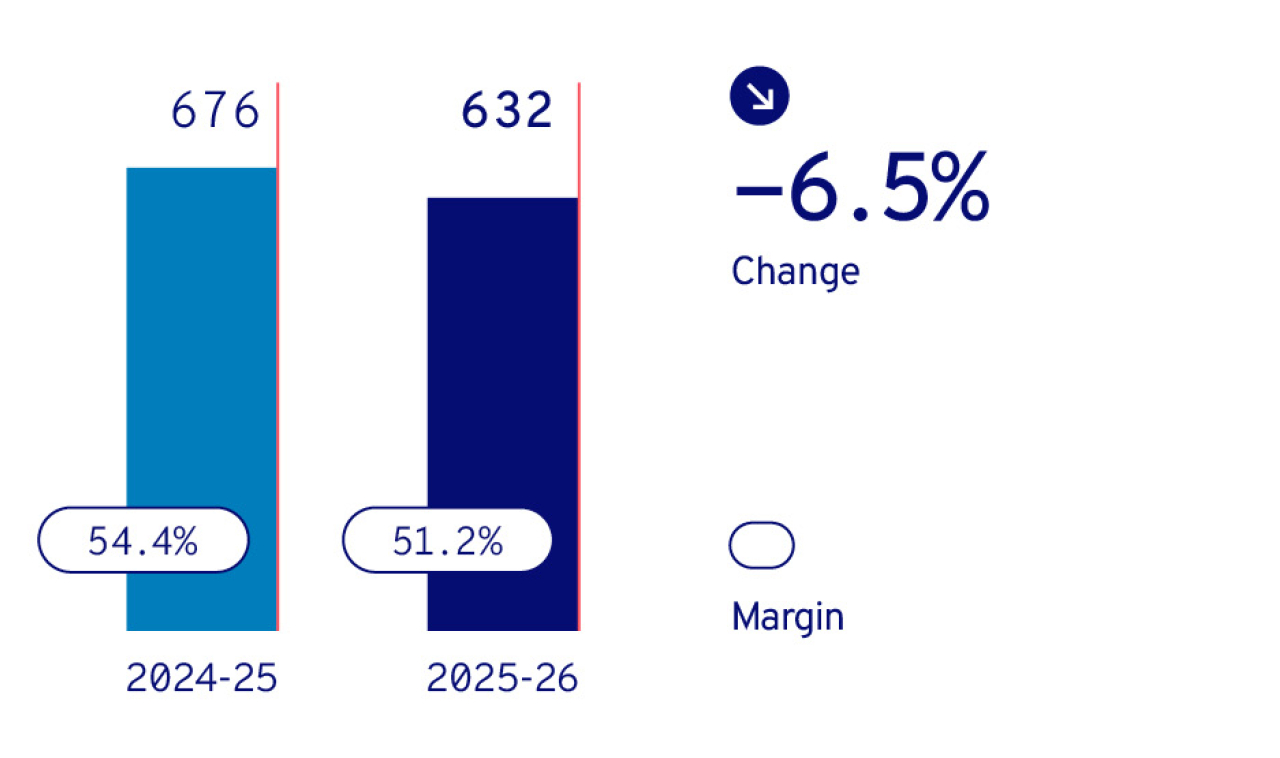
€632M
ADJUSTED EBITDA
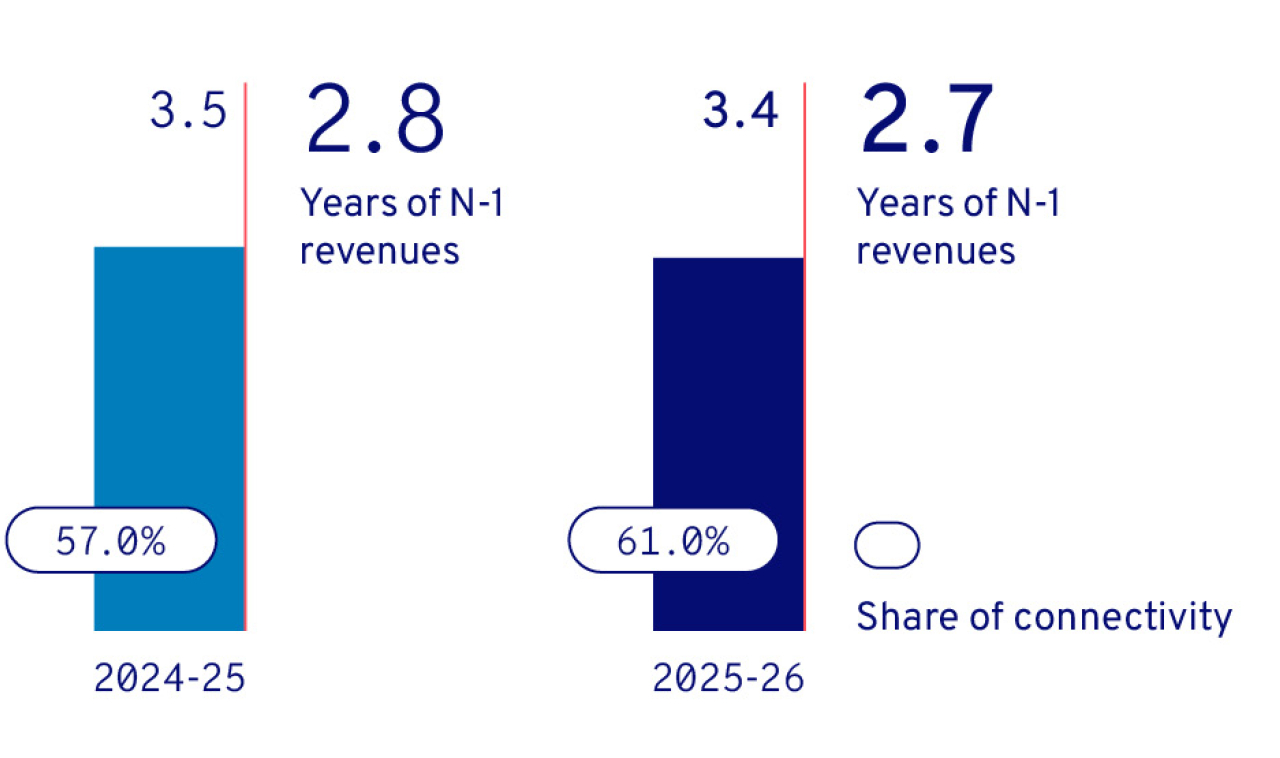
€3.4Bn
BACKLOG
€297M
LEO REVENUES

INVESTOR CONTACTS


INVESTOR RELATIONS

Hugo Laurens-Berge - Tel: +33 (0)6 70 80 95 58 

Christine Lopez - Tel: +33 (0)1 53 98 47 02

Email : investors@eutelsat-communications.com


Subscribe to our News :

Contact Corporate-Communications@eutelsat.com and receive the latest Eutelsat News in your inbox.


SHAREHOLDER SERVICES

Société Générale Securities Services

SGSS/SBO/CIS/ISS

32 rue du Champ de Tir

44308 Nantes Cedex 3, France 

Tel: +33 (0)2 51 85 67 89

Fax: +33 (0)2 51 85 62 15

www.sharinbox.societegenerale.com 

Industry
Corporate
First Quarter 2026-27 Revenues
  • LEO revenues up 30.1%1, driving sustained Connectivity growth of 11.9%1 
  • Operating Verticals revenues of €278 million, down 2.1%1
  • First Rendez-Vous now completed, IRIS² entering construction phase, with €8.9 billion of associated backlog recognised
  • All financial objectives confirmed

Paris, 29 October 2026 – Eutelsat Communications (ISIN: FR0010221234 - Euronext Paris / London Stock Exchange: ETL) reports revenues for the First Quarter ended 30 September 2026.
 

Q1 Results 2026-27
 
FIRST QUARTER REVENUES3

Total revenues for the First Quarter stood at €286 million, down 2.4% on a reported basis, and 0.9% like-for-like.

Revenues of the four Operating Verticals4 stood at €278 million. They were down 2.1% on a like-for-like basis excluding a slight currency effect. Quarter‑on‑quarter, revenues of the four Operating Verticals were down by 18.6% like-for-like.

Following the successful outcome of the IRIS² First Rendez-Vous, the project has now entered its construction phase, marking the transition from programme definition to industrial execution. With this milestone, the Group’s backlog now includes €8.9 billion of future revenues associated with the execution of construction-related activities under the programme. In this context, €5 million of revenue was recognised during the First Quarter, representing an initial contribution that is expected to increase materially over the remainder of the fiscal year as execution of the programme advances.

Note: Unless otherwise stated, all variations indicated hereunder are expressed on a like-for-like basis, i.e, at constant currency and perimeter.

Full Results available here

[1] Like-for-like change at constant currency and perimeter.

[2] Change at constant currency and perimeter. The variation is calculated as follows: i) Q1 FY 2026-27 USD revenues are converted at Q1 2025-26 rates; ii) Hedging revenues are excluded. There is no perimeter effect in the first quarter.

[3] The share of each application as a percentage of total revenues is calculated excluding “Other Revenues” and “IRIS2 Construction Revenues". 

[4] ie, excluding ‘Other Revenues’ and ‘IRIS2 Construction Revenues’.

IMAGE-Eutelsat-Logo
Industry
Corporate 0

Paris, 29 October 2026 – Eutelsat Communications reports revenues for the First Quarter ended 30 September 2026.

Read more press releases

Eutelsat and Qatar Media Corporation extend for broadcasting across MENA

•    Multi-year agreement secures the continued distribution of Qatar Media Corporation’s television services across the Middle East and North Africa

Paris, 26 October 2026 - Eutelsat (ISIN: FR0010221234 - Euronext Paris / London Stock Exchange: ETL) has renewed its longstanding partnership with Qatar Media Corporation (QMC), Qatar’s national public broadcasting organisation, for a new multi-year agreement for the distribution of its television services across the Middle East and North Africa (MENA) via the EUTELSAT 7 West A satellite.

Under the agreement, Qatar Media Corporation will continue to use Eutelsat’s satellite capacity and uplink services at the 7/8° West orbital position to deliver its national television bouquet to audiences throughout the region. The agreement follows the launch of QMC’s QBC Business Channel in 4K/UHD on Eutelsat’s 7/8° West video neighbourhood in May 2026.

Reaching 70 million homes, 7/8° West is the leading orbital position for satellite television across MENA, bringing together major public and private broadcasters and an extensive portfolio of Arabic and international content.

Hamad Elbordini, Sales Director MENA at Eutelsat, commented: “The extension of our longstanding partnership with Qatar Media Corporation is a strong demonstration of the continued trust placed in Eutelsat’s broadcast infrastructure and services. As Qatar’s national broadcaster, QMC plays an important role in the region’s media landscape, and we are pleased to continue supporting the reliable distribution of its content to audiences across MENA through our leading 7/8° West video neighbourhood.”

Saoud Al Maadeed, Deputy Director for Qatar Television at Qatar Media Corporation, added: “Our longstanding collaboration with Eutelsat has provided Qatar Media Corporation with the reach and reliability required to deliver our television services to audiences throughout the region. This new agreement ensures the continuity of our satellite distribution and reflects our shared commitment to providing viewers with high-quality and accessible content across MENA.”
 

Image of couple in the Middle East watching tv Getty Image: Middle Eastern couple watching TV at home
Industry
Corporate 0

Eutelsat has renewed its partnership with Qatar Media Corporation (QMC), Qatar’s national public broadcasting organisation, for the distribution of its television services across MENA via the EUTELSAT 7 West A satellite.

Read more press releases

Case study
Reliable satellite connectivity, even in the harshest winter conditions.

Expanding Remote Satellite Internet Access Across Greenland

Greenland's vast, frozen and mountainous terrain poses a highly complex connectivity challenge to national postal and telecommunications company Tusass. In 2025, Tusass signed a strategic partnership with Eutelsat to connect strategic sites on the ground to a resilient, low-latency communications network powered by the OneWeb low Earth orbit satellite system. Sites include critical infrastructure, maritime operations, emergency response and community broadband. 

The Challenge - Connectivity Strategy For A Unique Landscape

Greenland is part of the Kingdom of Denmark and a mountainous island three times the size of Texas that is mostly buried under an ice sheet. Many of its small communities scattered along the coast are hard to connect due to the combination of extreme weather and harsh terrain. These conditions make a fibre network too costly to install and maintain, while legacy geostationary satellite systems located above the equator struggle to provide optimal service this far north.

The Need - Agile Network Services For Fast-Changing Demands 

Local, low-latency, high-speed broadband communications are vital to Greenland’s increasingly international profile as well as to the distribution and delivery of critical services such as healthcare and economic development for its population. As an overseas country and territory of the EU, the government also receives funding from the European Union (EU) towards sustainable development, with a particular focus on education. Climate change scientists monitoring the island’s ecosystem are reliant on fresh data to determine what the ice melt that is occurring means for the rest of the world. Southern neighbours Canada and the US as well as Dennark and the EU both require reliable communications on the ground to maintain their strategic presence there.  In 2026 Canada announced plans to open a new consulate in the capital Nuuk. Offshore, Greenland’s maritime industry is it’s largest. Fishing accounts for more than 90% of exports. As climate change shrinks the ice sheet new shipping routes are opening up that need connectivity for strategic and commercial applications.

The Solution - LEO Partnership And Robust Installations

In 2025, Tusass expanded its partnership with Eutelsat to deploy LEO connectivity and deliver secure and resilient communications across the country’s vast and remote territory. The deployment supports Tusass in delivering on its strategic objectives for digital inclusion, infrastructure integration, and sovereign capacity across Greenland. The partnership ensures:

  • OneWeb LEO services: Eutelsat’s polar-orbiting satellite communications system offers low-latency, high-speed connectivity for Tusass services everywhere
  • Arctic-ready hardware: Ruggedised terminals and ground equipment are designed to withstand extreme cold, snow and wind
  • Hybrid network: LEO services complement Tusass's own fibre backbone and microwave infrastructure, to create a more resilient service and product portfolio
  • Portable and mobile capabilities: Approved hardware is equipped to support emergency response, maritime operations and remote access communications on-the-move as well as fixed

The Impact

Eutelsat's OneWeb LEO network has strengthened connectivity in some of Greenland's most challenging environments:

Greenland presents one of the world’s most complex connectivity challenges. By partnering with Eutelsat and its OneWeb LEO solution, we are strengthening our ability to meet the needs of our people and institutions.

Toke Binzer

Tusass CEO

Frequently Asked Questions

  • Satellite connectivity enables reliable broadband access for healthcare, education, emergency services and government operations across remote Greenland communities where terrestrial networks are impractical. Eutelsat's OneWeb LEO technology provides low-latency performance that supports real-time applications—telemedicine consultations, online learning platforms and emergency coordination. For public sector IT directors, this means continuity of essential services even in harsh Arctic conditions, with the responsiveness required for cloud-based workflows and video conferencing. The satellite service integrates with existing fibre and microwave infrastructure, creating a resilient hybrid network.

  • The equipment operates reliably in sub-zero temperatures, high winds and challenging field conditions—Eutelsat's OneWeb LEO solution uses approved hardware specifically designed to withstand extreme Arctic environments, supporting portable and mobile deployments for emergency response, maritime operations and remote community access. The equipment operates reliably in sub-zero temperatures, high winds and challenging field conditions—essential for first responders requiring rapid deployment without extensive site preparation. Portable terminals can be set up quickly at evacuation centres, temporary command posts or isolated settlements, providing secure, low-latency connectivity when terrestrial networks fail. This operational flexibility ensures critical communications remain available during disasters or infrastructure buildouts in remote areas.

  • Greenland's extreme latitude and rugged terrain make traditional geostationary satellite and terrestrial solutions challenging. Geostationary satellites orbit at approximately 35,786 kilometres, resulting in latency of 600 milliseconds or more—unsuitable for real-time applications. LEO satellites orbit much closer to Earth (around 1,200 kilometres for OneWeb), delivering latency comparable to terrestrial broadband. The hybrid model with Tusass leverages existing fibre backbone alongside LEO capacity, ensuring communities beyond submarine cable reach benefit from responsive, high-capacity connectivity. This approach provides the resilience required for mission-critical public services and emergency coordination.

  • Eutelsat's multi-orbit network combines GEO and LEO capabilities to provide resilience and continuous coverage across the Arctic. Hardware is ruggedised for extreme conditions, meeting the operational demands of government and emergency service users. The partnership with Tusass ensures local expertise and operational support, enabling rapid deployment and service management tailored to Greenland's unique geography and regulatory requirements. Network resilience features—including automatic failover and 24/7 monitoring—guarantee critical communications remain online even when individual network paths are disrupted.

Satellite connectivity LEO Greenland
Industry
Corporate Enterprise Government Maritime Satellite Network
Case study
A group of tourists form a human circle and dance through all the time zones.

Satellite-Based Live Coverage of Arctic Winter Games 2026

Eutelsat enabled professional live broadcasting from the Arctic Winter Games in Yukon, Northern Canada, using the OneWeb LEO satellite network. The low-latency, high-speed solution delivered reliable live video contribution from remote, high-latitude locations where traditional connectivity is limited.

The Challenge

The 2026 Arctic Winter Games brought together nearly 2,000 athletes from across the High North for a week of competition in Whitehorse, Yukon (60°43'27"N). For broadcasters, the high-latitude location and extreme environment posed a fundamental connectivity problem: they needed easy-to-deploy live transmissions from multiple venues that a local terrestrial cellular infrastructure would struggle to connect. At extreme latitudes, cellular coverage can prioritise voice and basic data over the high-bandwidth, low-latency demands of a live broadcast.

Key challenges included:

  • Limited high-speed connectivity for simultaneous HD video uplinks from multiple competition sites
  • Insufficient capacity to handle peak demand when several events streamed concurrently

Families and fans watching from their remote communities across Alaska, Nunavut and Greenland depended on a solution that could stream and deliver professional-grade video from such a challenging connectivity environment.

The Critical Need

Broadcasting a major multi-venue international sports event from the high Arctic demands more than basic satellite access. The Arctic Winter Games required deployable (comms-on-the-pause), high-capacity connectivity with the reliability to support modern professional broadcast workflows simultaneously from different locations.

The broadcast operations directors had three non-negotiable requirements:

  • Deployable connectivity capable of supporting live transmission from remote venues with limited infrastructure
  • Integrated network management treating all vehicles and uplink points as a single coordinated system
  • Traffic prioritisation for live feeds to ensure reliability during peak demand and concurrent transmissions

Low-latency performance was essential to meet broadcaster standards, whilst the system needed to handle multiple live feeds without degradation—even when multiple venues transmitted simultaneously.

The Solution: Deploying the OneWeb LEO Constellation

Canadian telecommunications company Northwestel deployed a multi-terminal configuration to deliver professional-grade broadcast connectivity across Arctic Winter Games venues:

  • Mobility Service Plan: Enterprise 150/30 service tier for guaranteed bandwidth
  • User terminals: OW11 and Hughes 1120 units mounted on vehicles for maximum mobility
  • Vehicular deployment: Mobile installations enabling live transmission from multiple event locations


The OneWeb LEO constellation provided the low-latency, high-capacity backbone required for real-time video contribution. Operating at 1,200 km altitude across 12 orbital planes, the network ensured continuous connectivity at 60°N latitude where traditional cellular infrastructure falls short.

Service plans were swiftly configured across all broadcast vehicles, with direct access to Eutelsat support and service management teams throughout the event. This integrated approach delivered the reliability professional broadcast and video solutions demand in challenging operating environments.

The Impact

The deployment delivered reliable, high-quality broadcast coverage across all Arctic Winter Games 2026 venues, enabling families and supporters throughout the circumpolar North to stream live action. By Combining Eutelsat's OneWeb LEO constellation with Northwestel's fibre infrastructure, the solution provided integrated high-speed connectivity from one of the world's most remote sporting locations.

Our partnership with Eutelsat has made it possible for us to provide connectivity to some of the most rugged and remote locations in Northern Canada. This project reflects our broader commitment to supporting the country’s highest authorities in their vision for innovation and digital transformation across the country.

Sheldon Lyslo

Business Development Director, Northwestel

Key outcomes included:

  • Live streaming across the circumpolar region with free livestream and on-demand coverage for families and communities
  • Multi-venue broadcast from 60°43′27″N demonstrating LEO performance in polar conditions
  • Seamless hybrid connectivity combining LEO and terrestrial paths for professional satellite news gathering solutions

Frequently Asked Questions

  • LEO satellite technology provides high-capacity, low-latency connectivity essential for professional video contribution where terrestrial infrastructure is unavailable. Operating at approximately 1,200 km above Earth, Eutelsat's OneWeb constellation delivers global coverage—including polar and high-latitude regions—with latency below that of traditional GEO systems. This enables broadcasters to transmit live video feeds in near real time, supporting multi-camera setups and simultaneous streams. The Arctic Winter Games deployment demonstrated this capability, enabling live coverage from 60°N latitude where cellular networks could not deliver necessary bandwidth or reliability.

  • Satellite-based live coverage offers signal reliability, scalable capacity during peak demand and seamless integration with existing production workflows. Unlike terrestrial networks that can suffer from congestion, satellite connections maintain consistent quality across vast geographies. LEO constellations deliver the low latency critical for live sports, where delays impact viewer experience. Managed service plans allow rapid configuration and traffic prioritisation, so production teams focus on content rather than connectivity logistics. For media operations directors, this means expanded viewership, optimised distribution costs and competitive advantage in reaching underserved or remote markets.

  • The OneWeb LEO network operates more than 600 satellites in 12 synchronised orbital planes, providing global coverage including polar regions where traditional constellations often fall short. This architecture ensures continuous satellite visibility and seamless handovers during live broadcasts. Deployable user terminals—such as the OW11 and Hughes 1120 used at the Arctic Winter Games—can be mounted on vehicles or set up at temporary venues, with service plans swiftly configured to match event requirements. Gateway stations and Points of Presence distributed worldwide bridge the constellation to the global internet, whilst managed support ensures broadcasters have direct access to technical expertise throughout the event.

  • Eutelsat provides comprehensive satellite solutions combining both GEO and LEO capabilities within a unified multi-orbit network. The company's fleet of GEO satellites deliver high-throughput capacity and wide regional footprints, whilst the OneWeb LEO constellation adds global reach and low-latency performance. For live events, Eutelsat offers managed service plans with flexible capacity, deployable terminals for rapid setup and turnkey solutions integrating satellite with terrestrial and IP feeds. This hybrid approach supports multi-venue deployments, traffic prioritisation during peak demand and resilient backup connectivity—enabling media organisations to deliver high-quality content reliably from the world's most remote locations.

Broadcasting live events Broadcast and video Satellite broadcasting LEO satellite broadcasting
Industry
Corporate
Eutelsat Welcomes FCC Upper C-Band Decision
  • Eutelsat to receive total incentive payments of $504 million
  • Transition to be implemented over the coming years in close coordination with FCC, customers and relevant stakeholders to ensure uninterrupted service

Paris, 27 July 2026 – Eutelsat (ISIN: FR0010221234 – Euronext Paris / London Stock Exchange: ETL) welcomes the order of U.S. Federal Communications Commission (FCC), establishing the regulatory framework for the transition of Upper C-band spectrum in the United States and creating the conditions for an orderly transition of satellite services.

The FCC's order provides the framework for the reallocation of 160 MHz of Upper C-band spectrum to support the continued expansion of advanced wireless services across the United States while ensuring the continuity of critical satellite services. The framework also establishes the process for the orderly transition of incumbent satellite operators over the coming years.

The decision provides regulatory certainty for the implementation of the transition while preserving the critical role of satellite infrastructure in delivering essential connectivity services.

Under the provisions of the order, Eutelsat will receive incentive payments of $504 million (€443 million) pre-tax, conditional upon the completion of the transition within the two established deadlines and expected during 2031.

Eutelsat will also be fully reimbursed for costs incurred during the transition process.

Jean‑François Fallacher, Chief Executive Officer of Eutelsat, said: "We welcome the order published by the FCC, representing an important milestone for the U.S. satellite and telecommunications industries. It establishes a clear framework that enables additional spectrum to be made available for advanced wireless services while safeguarding the continuity of satellite operations. Eutelsat is committed to working with the FCC and other stakeholders to ensure the transition is executed in a timely manner which is seamless for customers.”

IMAGE-PRESSE-Eutelsat-27-07-2026.webp 3459314 Paris, France, Eutelsat-2026
Industry
Corporate 0

Eutelsat welcomes the order of U.S. Federal Communications Commission (FCC), establishing the regulatory framework for the transition of Upper C-band spectrum in the United States and creating the conditions for an orderly transition of satellite services.

Mynewsdesk Source ID
3459314
Subscribe to Corporate