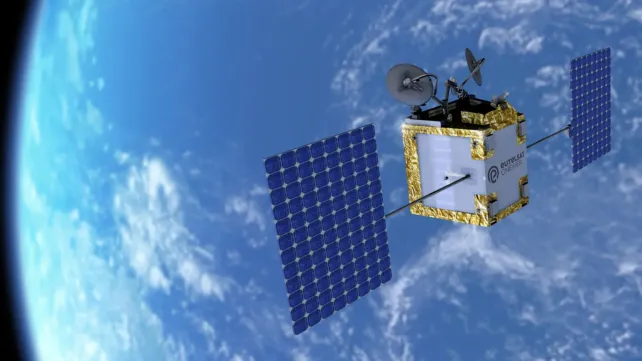
Eutelsat, MediaTek and Airbus complete world-first 5G NTN trial
· Eutelsat becomes the first satellite operator to demonstrate the 5G air interface working on a commercial fleet
· Paving the way for deployment of 5G NTN and interoperability between terrestrial and satellite technologies
· Placing Eutelsat at the forefront of 5G NTN innovation, a key feature of the future IRIS2 constellation
Paris, 24 February 2025 – Eutelsat Group (ISIN: FR0010221234 - Euronext Paris / London Stock Exchange: ETL), MediaTek Inc. and Airbus Defence and Space have conducted the world’s first successful trial of 5G Non-Terrestrial Network (NTN) technology over the Eutelsat OneWeb low Earth orbit (LEO) satellites. The tests pave the way for deployment of the 5G NTN standard, which will result in future satellite and terrestrial interoperability within a large ecosystem, lowering the cost of access and enabling the use of satellite broadband for 5G devices around the world.
The trial used Eutelsat OneWeb satellites, with the MediaTek NR NTN test chipset, and NR NTN test gNB provided by ITRI, implementing the 3GPP Release 17 specifications. Sharp, Rohde & Schwarz provided the antenna array and test equipment and the LEO satellites, built by Airbus, carry transponders, with Ku-band service link, Ka-band feeder link, and adopt the “Earth-moving beams” concept. During the trial, the 5G user terminal successfully connected to the 5G core via the satellite link and exchanged traffic.
With the integration of 5G standards shared and accepted by the entire mobile industry, all compatible satellite constellations will naturally and seamlessly complement terrestrial networks, enabling truly ubiquitous connectivity with economies of scale, and opening up new markets for smartphones, the automotive industry and the Internet-of-Things.
Arlen Kassighian, Chief Engineering Officer at Eutelsat Group, said: “These trials show the commitment of Eutelsat Group in developing and adopting new technologies, in order to provide the best possible services to our customers, in collaboration with trusted partners. 5G NTN will be a key feature of the IRIS2 constellation, and Eutelsat is at the forefront of this innovation and active member of the ecosystem. We are proud to be the first satellite operator to demonstrate the 5G air interface working on a commercial fleet in Ku-band and paving the way for new applications in future constellations.”
“As a global leader in terrestrial and non-terrestrial connectivity, we continue in our mission to improve lives by enabling innovative technology that connects the world around us, even in areas with little to no cellular coverage,” said Mingxi Fan, Head of Wireless System and ASIC Engineering at MediaTek. “By making real-world connections with LEO satellites in orbit, we are now another step closer to bring the next generation of 3GPP-based NR-NTN satellite wideband connectivity for commercial use.”
Elodie Viau, Head of Space Systems Engineering at Airbus added: “Demonstrating successful 5G NTN satellite connectivity using the Airbus built OneWeb satellites not only proves the flexibility and innovative design of the satellites but opens the prospect of true global satellite broadband connectivity for 5G devices. As a pioneer in space connectivity, we are actively contributing to the development of 5G NTN, and we look forward to the next stage of further integrating satellites in our everyday lives.”
Eutelsat Group (ISIN: FR0010221234 - Euronext Paris / London Stock Exchange: ETL), MediaTek Inc. and Airbus Defence and Space have conducted the world’s first successful trial of 5G Non-Terrestrial Network (NTN) technology over the Eutelsat OneWeb low Earth orbit (LEO) satellites.
First batches targeted for delivery from end-2026, assuring service continuity and enhancement for existing and future customers
Paving the way for the future IRIS2constellation
Fully compatible with Eutelsat’s FY 2025 Capital Expenditure guidance and longer-term financial framework
Paris, 17 December 2024 - Eutelsat Group (ISIN: FR0010221234 - Euronext Paris / London Stock Exchange: ETL), has selected Airbus Defence and Space to build the extension of its OneWeb low Earth orbit (LEO) constellation.
Under a contract signed between the two companies, Airbus will build the first batches of the extension, totalling 100 satellites, with delivery targeted starting end of calendar-2026, ensuring continuity and enhancement of service for current and future customers.
The new satellites will embark key technology upgrades, notably 5G on-ground integration. They will be technologically compatible with Europe’s IRIS2 constellation, paving the way for its entry into operational service in 2030, and of which Eutelsat will be the main architect and operator of the LEO segment.
The procurement of these satellites is integrated within Eutelsat’s Capital Expenditure outlook for 2025, and fully compatible with its longer-term financial framework.
Eva Berneke, Chief Executive Officer of Eutelsat Group commented:"We are relying on our long-standing partner, Airbus, to begin building the first batches of the Next Generation of our OneWeb LEO constellation, which will ensure we deliver continuity of service of the existing constellation with enhanced service features, as we move towards an architecture in line with the IRIS2constellation in 2030. Our in-market experience shows us that the appetite for low Earth orbit capacity is growing rapidly, and we are excited to embark on the next stage of our journey to satisfy that demand.”
Eutelsat Group has selected Airbus Defence and Space to build the extension of its OneWeb low Earth orbit (LEO) constellation. Under a contract signed between the two companies, Airbus will build the first batches of the extension, totalling 100 satellites, with delivery targeted starting end of calendar-2026, ensuring continuity and enhancement of service for current and future customers.
Landmark public-private partnership unlocking economies of scale and de-risked through anchor sovereign customer commitment
Representing a key step in Eutelsat’s strategy to develop and expand its low Earth orbit capacities
Fully consistent with Eutelsat’s financial framework
Paris, 16 December 2024 - SpaceRISE, the consortium comprising Eutelsat (ISIN: FR0010221234 - Euronext Paris / London Stock Exchange: ETL), Hispasat, and SES, has signed the agreement that will see the consortium design, build, and operate the IRIS² (Infrastructure for Resilience, Interconnectivity and Security by Satellite) constellation on behalf of the European Union under a Public-private Partnership (PPP) model in the form of Concession with an initial duration of 12 years.
The constellation will comprise around 290 spacecraft including 264 low Earth orbit (LEO) and 18 medium Earth orbit (MEO) satellites and is expected to be in service in 2030. The EU and Member States will be the anchor customers of the IRIS2 constellation, which will deliver enhanced communication solutions and high-speed broadband connectivity for consumers, governments and businesses, reinforcing Europe’s digital sovereignty and security.
The project is valued at some €10.6 billion, with public funding from the European Commission, EU Member States, and the European Space Agency representing c. 60% of the total project cost, supplemented by private financing from the consortium members. Eutelsat will invest in the region of €2 billion, back-end loaded to the later stages of the project.
Eutelsat will act as Consortium System Development Prime, the technical authority within the consortium. In this role it will leverage its unique LEO expertise and make available its priority spectrum rights in the Ku band to lead on the design of the LEO segment of the constellation, as well as co-leading on the conception of the common elements. Eutelsat will benefit, along with the other SpaceRISE members, from the scale advantages of shared fixed costs and R&D investments in the development of new technologies, while revenues from the EU will flow in during the build phase covering the up-front operating costs of the concessionaire. Finally, it will benefit, alongside its SpaceRISE partners, from commitments from the Commission and Member States for IRIS2 capacity to the tune of several hundred million Euros.
Eutelsat’s involvement in IRIS2 represents a key step in the company’s strategy to develop and expand its low Earth orbit capacities, and the extension of its existing OneWeb constellation will be technologically compatible with the future IRIS2 assets. Once operational the IRIS² constellation will offer compelling complementarity with Eutelsat’s existing LEO business, notably giving Eutelsat access to additional sellable LEO capacity secured by its investment of at least 1.5 Tbps out of a total of 2 Tbps of LEO capacity, at an attractive cost per Gbps, as well as to KaMil capacity not consumed by EU sovereign needs. Eutelsat will also be able to complete IRIS2 with further satellites to scale up capacity and carry additional payloads based on demand.
The project is fully consistent with Eutelsat’s financial framework and compatible with its required returns on investment. Eutelsat’s financial commitment is clearly capped, while the agreement signed today comprises protections to support the economics of the project including notably strict milestones providing for exit possibilities and compensation for consortium members in the event of missed of delayed targets compromising anticipated returns. Over the period of the concession, Eutelsat expects to generate revenues of at least 6.5 billion euros, derived from anchor EU customers as well as the global distribution of its LEO capacities to commercial customers.
Commenting of the agreement, Eva Berneke, Chief Executive Officer of Eutelsat said: “IRIS² is a landmark initiative that embodies Europe’s commitment to digital sovereignty, resilience, and strategic autonomy. Eutelsat is uniquely positioned to bring unparalleled expertise to this mission, leveraging our unique LEO expertise and spectrum priority. By combining this advanced infrastructure with the collective strengths of the SpaceRISE consortium, we will deliver a transformative communications backbone that addresses Europe’s most critical connectivity needs, reinforces its leadership in space innovation, and bridges the digital divide for millions of citizens and businesses across the continent.”
3360767
Rendering of IRIS² constellation. Credit: SES
SpaceRISE, the consortium comprising Eutelsat, Hispasat, and SES, has signed the agreement that will see the consortium design, build, and operate the IRIS² (Infrastructure for Resilience, Interconnectivity and Security by Satellite) constellation on behalf of the European Union under a Public-private Partnership (PPP) model in the form of Concession with an initial duration of 12 years.
IRIS² will play a transformative role in reinforcing Europe’s resilience, digital sovereignty, and low-latency connectivity for all EU Member States. This IRIS² multi-orbit satellite system is intended to enhance Europe’s ability to respond to crises, protect essential infrastructure, and bridge the digital divide. With full operational status targeted for the early 2030s, IRIS² will deliver a secure and competitive communications backbone aligned with Europe’s strategic and digital priorities.
The IRIS2 programme is a public private partnership (PPP) which will be funded by a combination of EU, European Space Agency and private financing from the three satellite operators within the SpaceRISE consortium.
The consortium looks forward to the final phase of the procurement process leading to contract signature expected by the year end.
Eva Berneke, Chief Executive Officer of Eutelsat commented: “The IRIS² programme is a powerful extension of Eutelsat’s commitment to advancing Europe’s digital sovereignty through sustained investment in multi-orbit technology to deliver multi-layered, low-latency networks, which are essential to Europe’s strategic resilience. We are proud to support the EU on this project alongside the consortium partners to deliver a resilient, future-ready communication system that meets Europe’s most critical connectivity needs, while generating value-creation for Eutelsat and its stakeholders by complementing and enhancing our existing LEO capabilities."
Miguel Ángel Panduro, Chief Executive Officer of Hispasat added: "We are firmly committed to everything that IRIS² represents: a sovereign secure communications system, supported by European innovative developments and driven by public-private partnership. It is an ambitious project, in which the companies of the SpaceRISE consortium are working to offer the best response to the demands of the European Union. This award is an exciting first step of a project that will define the future of satellite communications in Europe."
Adel Al-Saleh, Chief Executive Officer of SES said: “Being selected as a trusted partner for IRIS² is an honour. SpaceRISE, based on the European Union’s requirements will define and develop a future-proof space network that will serve as the cornerstone of Europe’s space and defence strategies in the years to come. The IRIS² system is aligned with SES’s multi-orbit network and underscores our commitment to advancing our MEO capabilities, as well as having access to LEO orbit. We will continue to ensure that the contract meets our IRR requirements, cash generation fundamentals, and investment grade metrics.”
SpaceRISE, the consortium comprising Eutelsat (ISIN: FR0010221234 - Euronext Paris / London Stock Exchange: ETL), Hispasat and SES (Ticker: SESG), together with other core members, is pleased to announce it has been awarded by the European Commission to design, deliver, and operate IRIS², the European Union’s pioneering multi-orbit connectivity system.
Latest launch adds additional satellites in low Earth orbit to OneWeb constellation
New satellites will increase network strength and redundancy
Paris, France 20 October 2024 - Eutelsat Group (ISIN: FR0010221234 - Euronext Paris / London Stock Exchange: ETL) is pleased to announce the successful launch and deployment of 20 satellites into low Earth orbit (LEO), further strengthening the OneWeb constellation.
The satellites were launched aboard SpaceX’s Falcon 9 which lifted off at 10:13 pm PT (local) on October 19 from Space Launch Complex 4 East (SLC-4E) at Vandenberg Space Force Base in California. The satellites separated successfully from the vehicle and were dispensed in 10 batches over a period of 20 minutes, with signal acquisition confirmed on all 20 satellites. The satellites were built by Airbus U.S. Space & Defense in Merritt Island, Florida.
This launch occurs following the one-year anniversary of the merger between Eutelsat and OneWeb to create the world’s only GEO-LEO operator. Eutelsat Group is uniquely positioned to offer customers the advantages of GEO for high-throughput capacity alongside the low-latency, high-speed global connectivity provided by LEO satellites. Since the merger, Eutelsat has seen a significant increase in demand for multi-orbit services, and is collaborating with industry leaders such as Intelsat, Inmarsat Maritime, and Hughes to deliver cutting edge connectivity services worldwide, across sectors.
Eva Berneke, CEO of Eutelsat Group, commented: “We are delighted to see the successful launch and deployment of new OneWeb satellites. These satellites will strengthen our network services, improving overall performance for our customers. As we celebrate the anniversary of the merger with Eutelsat and OneWeb, we are excited by the growing demand for our multi-orbit services and we remain committed to delivering value for our customers and shareholders. I want to thank and congratulate the teams at Eutelsat Group and SpaceX for their hard work to facilitate this launch.
Eutelsat Group is pleased to announce the successful launch and deployment of 20 satellites into low Earth orbit, further strengthening the OneWeb constellation.
First agreement between Eutelsat Group and MHI for launches
New agreement adds additional launch options for Eutelsat
Paris, France, Tokyo, Japan: 18 September 2024 – Eutelsat Group (ISIN: FR0010221234 - Euronext Paris / London Stock Exchange: ETL), and Mitsubishi Heavy Industries Ltd. (“MHI”), announce the signature of an agreement for multiple launches. Under the terms of the agreement, MHI will provide multiple launches by an H3 launch vehicle from 2027.
This is the first agreement between Eutelsat and MHI, and today’s announcement cements the growing partnership between both companies.
Eutelsat has consistently worked with leading launch providers to deliver its fleet into orbit and this latest agreement brings additional diversity and additional opportunities to launch Eutelsat’s satellites in the coming years.
Arlen Kassighian, Chief Engineering Officer of Eutelsat Group, said: “We are delighted to inaugurate our relationship with MHI with this multi-launch agreement. Access to space is critical for operators like Eutelsat, and we are excited to add MHI to our portfolio of launches, knowing that we can rely on its outstanding track record and technology to deliver our satellites into orbit.”
Iwao Igarashi, Vice President and Senior General Manager of Space Systems at MHI, said: “MHI deeply appreciates the honor of entering into the first launch agreement with Eutelsat, the global leading satellite operator, and being selected as their launch partner to deploy their satellites. MHI is committed to delivering highly reliable and transparent launch services for its customers, that build market trust through the accumulation of successful launches. We look forward to developing a long-lasting and mutually beneficial partnership with Eutelsat.”
Paris, France, Tokyo, Japan: 18 September 2024 – Eutelsat Group and Mitsubishi Heavy Industries Ltd. (“MHI”), announce the signature of an agreement for multiple launches. Under the terms of the agreement, MHI will provide multiple launches by an H3 launch vehicle from 2027.
Paris, 31 March 2024 - Eutelsat Group (ISIN: FR0010221234 - Euronext Paris / London Stock Exchange: ETL) today announces the successful launch and deployment of its EUTELSAT 36D satellite. SpaceX’s Falcon 9 rocket launched the satellite into a Geostationary Transfer Orbit (GEO) on March 30, 2024 at 5:52 p.m. ET from Launch Complex 39A at Kennedy Space Center, Florida, USA.
Based on the Airbus Eurostar Neo platform, EUTELSAT 36D will replace EUTELSAT 36B, at the 36° East orbital position, where it will operate alongside EUTELSAT 36C. Embarking 70 physical Ku-band transponders, the satellite will assure service continuity with optimised performance for customers in Video over its footprint. The satellite also includes additional flexibility and coverage options, enabling to balance the loading between its different missions.
Eva Berneke, CEO of Eutelsat Group, commented:“EUTELSAT 36D is now on its way to replace EUTELSAT 36B at the 36° East orbital position. We are looking forward to its entry into service in the second half of calendar 2024. This is also an opportunity to take our long-lasting relationship with Airbus to the next level. My congratulations to the Eutelsat Group, Airbus and SpaceX teams for the completion of another successful satellite program.”
Eutelsat Group (ISIN: FR0010221234 - Euronext Paris / London Stock Exchange: ETL) today announces the successful launch and deployment of its EUTELSAT 36D satellite. SpaceX’s Falcon 9 rocket launched the satellite into a Geostationary Transfer Orbit (GEO) on March 30, 2024 at 5:52 p.m. ET from Launch Complex 39A at Kennedy Space Center, Florida, USA.
Paris, 02 February 2024 - Eutelsat Group (ISIN: FR0010221234 - Euronext Paris / London Stock Exchange: ETL) confirms that following an anomaly on its EUTELSAT 113 West A satellite which occurred on 31st January, it has ceased operations on the satellite.
Launched in 2006 and operating in inclined orbit at the 113° West position, EUTELSAT 113 West A (ex-Satmex 6) provided coverage of the Americas in C- and Ku-bands serving customers in video, data, and Government services on 18 operational transponders.
Mitigation actions are underway to minimize the disruption to customers impacted, including accelerated transfer to alternative capacity on our satellites located at the 115° and 117° West positions.
Eutelsat Group teams are deploying all possible efforts to mitigate the potential adverse consequences on orbital safety. Eutelsat Group reaffirms its commitment to a safe and sustainable space environment.
Approaching its end-of-life, the satellite is no longer part of the In Orbit Insurance policy. Before mitigation, the mechanical impact on revenues of the non-availability of the satellite is circa €3m in FY24 and €5-6m per annum for the period FY25-28. It does not alter our financial objectives for FY 2024.
Eutelsat Group (ISIN: FR0010221234 - Euronext Paris / London Stock Exchange: ETL) confirms that following an anomaly on its EUTELSAT 113 West A satellite which occurred on 31st January, it has ceased operations on the satellite.
Launched in March 2023, Kymeta’s compact, low-power HawkTM u8 LEO terminal, will now be available for communications on the move.
Redmond, WA — December 14, 2023 – World-leading flat panel satellite antenna company Kymeta (www.kymetacorp.com) and satellite communications company Eutelsat Group (eutelsat.com) today announced that the Kymeta electronically steered Hawk u8 LEO terminal is now approved for land mobility on the Eutelsat OneWeb LEO network, becoming the first flat panel antenna to be approved on its LEO network for land mobility.
This offering unlocks a new era of connectivity for customers who require exceptional performance and reliable connectivity while on the move. Kymeta’s deep roots in providing mobility extend back to the launch of its first product in 2017. By tapping into Eutelsat OneWeb’s enterprise-grade connectivity network, all vehicles can now connect easily and seamlessly on the pause and on the move.
“This is an exciting time as we see every major industry such as emergency management, on-road fleets and rail operators wanting to tap into mobile broadband as an efficient and effective means to transform their operations,” said Walter Berger, President and Co-CEO, Kymeta, “As a proud partner of Eutelsat Group, today marks a milestone for Kymeta because it represents the fulfillment of our joint commitment to enable satellite communications on the move globally.”
Massimiliano Ladovaz, Chief Operations Officer at Eutelsat Group, said “Kymeta offers a high-bandwidth, low-power, fully integrated family of high throughput mobile terminals. Eutelsat OneWeb’s LEO satellite network will give Kymeta customers access to high-speed, low-latency broadband connectivity while on the move or while stationary even in the remotest parts of the world.”