
Satellite-Based Live Coverage of Arctic Winter Games 2026
The Challenge
The 2026 Arctic Winter Games brought together nearly 2,000 athletes from across the High North for a week of competition in Whitehorse, Yukon (60°43'27"N). For broadcasters, the high-latitude location and extreme environment posed a fundamental connectivity problem: they needed easy-to-deploy live transmissions from multiple venues that a local terrestrial cellular infrastructure would struggle to connect. At extreme latitudes, cellular coverage can prioritise voice and basic data over the high-bandwidth, low-latency demands of a live broadcast.
Key challenges included:
- Limited high-speed connectivity for simultaneous HD video uplinks from multiple competition sites
- Insufficient capacity to handle peak demand when several events streamed concurrently
Families and fans watching from their remote communities across Alaska, Nunavut and Greenland depended on a solution that could stream and deliver professional-grade video from such a challenging connectivity environment.
The Critical Need
Broadcasting a major multi-venue international sports event from the high Arctic demands more than basic satellite access. The Arctic Winter Games required deployable (comms-on-the-pause), high-capacity connectivity with the reliability to support modern professional broadcast workflows simultaneously from different locations.
The broadcast operations directors had three non-negotiable requirements:
- Deployable connectivity capable of supporting live transmission from remote venues with limited infrastructure
- Integrated network management treating all vehicles and uplink points as a single coordinated system
- Traffic prioritisation for live feeds to ensure reliability during peak demand and concurrent transmissions
Low-latency performance was essential to meet broadcaster standards, whilst the system needed to handle multiple live feeds without degradation—even when multiple venues transmitted simultaneously.
The Solution: Deploying the OneWeb LEO Constellation
Canadian telecommunications company Northwestel deployed a multi-terminal configuration to deliver professional-grade broadcast connectivity across Arctic Winter Games venues:
- Mobility Service Plan: Enterprise 150/30 service tier for guaranteed bandwidth
- User terminals: OW11 and Hughes 1120 units mounted on vehicles for maximum mobility
- Vehicular deployment: Mobile installations enabling live transmission from multiple event locations
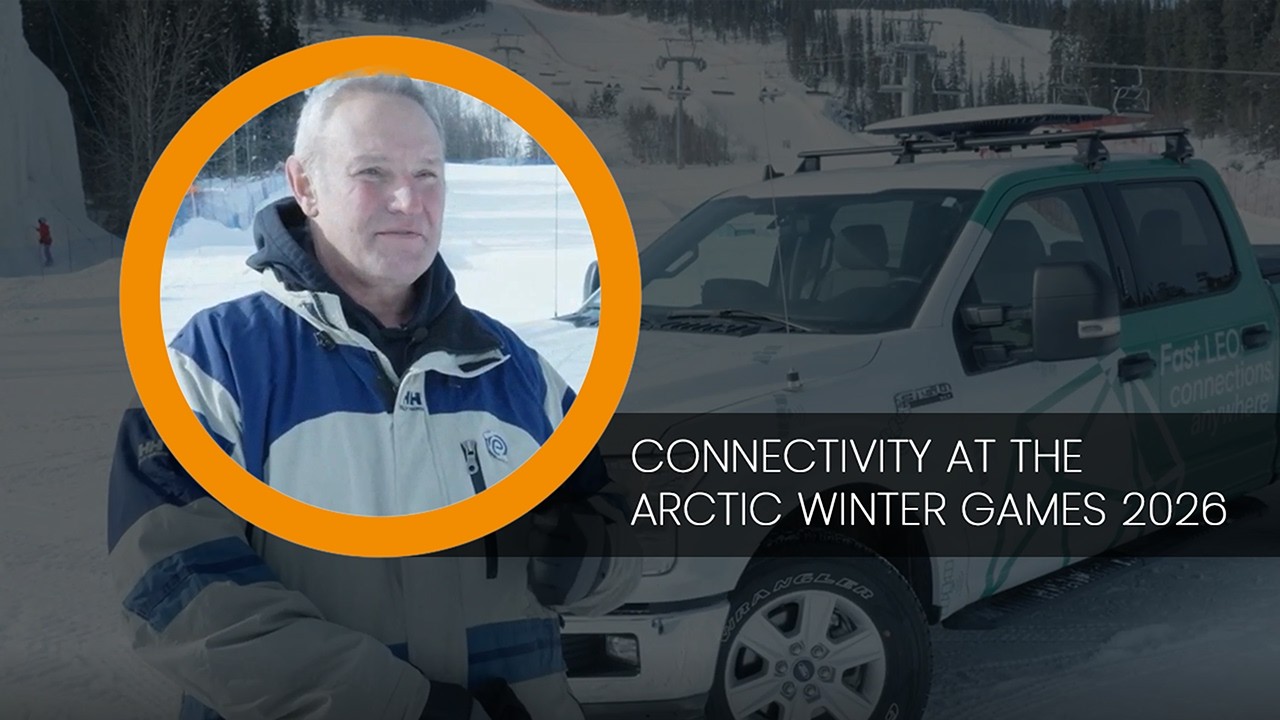
The OneWeb LEO constellation provided the low-latency, high-capacity backbone required for real-time video contribution. Operating at 1,200 km altitude across 12 orbital planes, the network ensured continuous connectivity at 60°N latitude where traditional cellular infrastructure falls short.
Service plans were swiftly configured across all broadcast vehicles, with direct access to Eutelsat support and service management teams throughout the event. This integrated approach delivered the reliability professional broadcast and video solutions demand in challenging operating environments.
The Impact
The deployment delivered reliable, high-quality broadcast coverage across all Arctic Winter Games 2026 venues, enabling families and supporters throughout the circumpolar North to stream live action. By Combining Eutelsat's OneWeb LEO constellation with Northwestel's fibre infrastructure, the solution provided integrated high-speed connectivity from one of the world's most remote sporting locations.
Our partnership with Eutelsat has made it possible for us to provide connectivity to some of the most rugged and remote locations in Northern Canada. This project reflects our broader commitment to supporting the country’s highest authorities in their vision for innovation and digital transformation across the country.
Business Development Director, Northwestel
Key outcomes included:
- Live streaming across the circumpolar region with free livestream and on-demand coverage for families and communities
- Multi-venue broadcast from 60°43′27″N demonstrating LEO performance in polar conditions
- Seamless hybrid connectivity combining LEO and terrestrial paths for professional satellite news gathering solutions