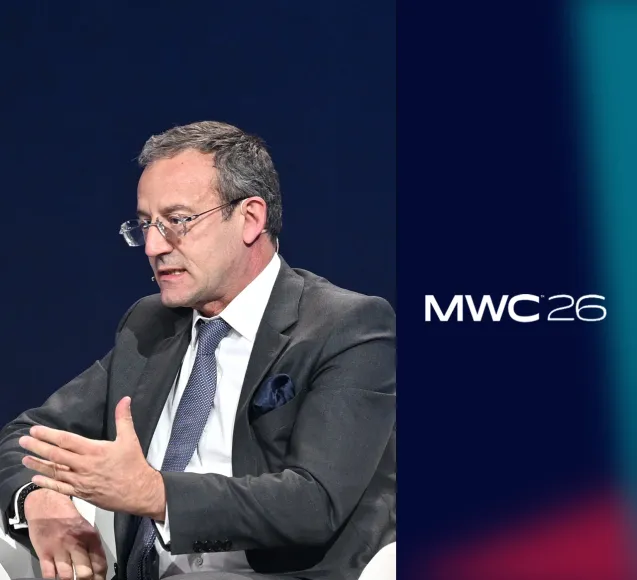
Jean-François Fallacher, Mobile World Congress, Barcelona 2026
Europe's path to tech sovereignty
At MWC Barcelona, Jean François Fallacher, Eutelsat's CEO, shared his perspective on sovereign connectivity and why LEO satellite constellations have become strategic assets for Europe. This article reflects his contribution to the keynote panel discussion, exploring how Eutelsat’s OneWeb constellation supports Europe’s sovereignty, resilience and security in an increasingly competitive global landscape.
WHY LEO CONSTELLATIONS HAVE BECOME STRATEGIC ASSETS
A European Champion Competing in a World of Giants
Eutelsat stands at the centre of Europe’s space ecosystem, with a 47year legacy and a fleet of 33 geostationary satellites. The company’s strategic transformation accelerated with the acquisition of OneWeb — today one of only two operational low Earth orbit (LEO) constellations in the world. Jean François highlighted that it remains the only LEO constellation not controlled by the US or China, giving Europe a uniquely sovereign asset. To reinforce this position, Eutelsat has secured €1.5 billion in new capital to expand the fleet by 440 satellites, bringing the constellation to roughly 650 units by 2030. “We are the sovereign European constellation. We have European shareholders. We are listed on the Paris and London stock exchanges.” He also pointed to the company’s central role in IRIS², the European Commission’s next generation secure connectivity programme. LEO activities now account for 20% of turnover and continue to grow at around 60% year over year.
Why LEO Is Essential for Europe’s Sovereignty
LEO constellations are a critical pillar for Europe’s digital autonomy. They deliver seamless global broadband and require massive, long-term investment, making them difficult to replicate. Jean François noted that OneWeb had already absorbed seven years of development and $7 billion before Eutelsat acquired it — a reminder of its scale and strategic relevance. “[LEO constellations] are extremely large and capital-intensive infrastructures… This is why we believe LEO is a strategic asset — a strategic service — for Europe.” He also raised the emerging opportunity of Direct-to-Device (D2D) connectivity, an area poised to transform the communications landscape. While Europe has strong projects underway, he stressed that achieving D2D at scale will require significant investment and a clear, unified industrial ambition.
Serving Governments and Critical IndustrieS
Eutelsat’s OneWeb LEO constellation focuses on high reliability B2B markets — governments, aviation, maritime, enterprise and defence. A landmark €1 billion, 10year agreement with the French Ministry of Defence underscores the constellation’s strategic importance. This partnership strengthens operational access and supports further hardening of the system for defence and national-security use cases. Recent geopolitical events continue to highlight the risks of dependency on foreign controlled connectivity. Jean François emphasised that sovereignty becomes very real when an external operator can unilaterally restrict service over a conflict zone. Eutelsat’s European governance and operational control directly address this vulnerability.
We believe LEO is a strategic asset - a strategic service - for Europe.
Europe needs [...] more agility, faster development and a culture of iteration [to] master the key technologies we still have to import today.
JEan-François FALLACHER
CEO, EUTELSAT
Why Europe Needs to Act Together
Europe faces global competition from large American and Chinese constellations. Jean François warned that fragmented national initiatives would undermine Europe’s ability to match this scale. A coherent and unified approach — particularly around IRIS² — is essential to maintain a sovereign position in orbit. “The geopolitical situation has given us real momentum. People now realise that sovereignty is not theoretical. When one of our competitors [,,,] decides to cut services over a country, that marks the spirit. The dependency becomes immediately visible.”
Europe’s Cultural Inflection Point
Europe’s technological expertise remains strong, but development speed is a critical challenge. The “new space” economy depends on agility, fast iteration and shorter development cycles. Jean François noted that Europe must adopt these practices if it is to maintain leadership and regain control over key technologies still sourced externally. “This is why Eutelsat is advocating for unity — not only around Eutelsat, but for the European project to build the next-generation constellation, IRIS². For IRIS² to succeed, we need all European countries and public funding united behind one sovereign approach.”
Looking Ahead
The message from MWC Barcelona is clear: Europe has the talent, industrial capability and technological foundation to lead in space — but only if it acts with unity and urgency. A sovereign LEO constellation is not just a technological milestone; it is a cornerstone of Europe’s resilience, economic strength and strategic independence. "In new space, companies are already working in agile, fast cycles. This is what Europe needs — in mindset and practice: more agility, faster development, and a culture of iteration. That’s how we will master more of the key technologies we still have to import today."
General Hospital & Trauma Center, San Francisco, USA
Leo connectivity for hospital communications
Connectivity in action : Satellite integration delivers fast and reliable connectivity in hospital environments.
Hospital Emergency Connectivity: How San Francisco General Stays Online in Any Crisis
San Francisco General, one of Northern California's busiest public hospitals, must remain operational through power outages, disasters and network disruptions. Emergency departments depend on uninterrupted connectivity to coordinate patient care. To strengthen emergency readiness, Eutelsat Distribution Partner IP Access International and Remote Satellite Systems International integrated a blended satellite solution that keeps hospital communications online when traditional networks fail.
The Challenge: Maintaining Critical Communications
Emergency departments depend on continuous connectivity to coordinate patient care, yet power outages, disasters and damaged fibre lines can sever communications when they are needed most. Congested cellular networks add further risk during large-scale incidents.
The challenge is particularly acute when:
First responders transmit vital signs, electrocardiograms and patient history from ambulances before arrival
Health information exchange between paramedics and receiving staff requires real-time data flows
Trauma and stroke cases demand instant coordination across departments, buildings and partner agencies
Non-technical staff have to implement and follow complex back-up communications protocols in the event of failover
The Need: A Unified Satellite-Backed Network
San Francisco General needed connectivity to remain operational regardless of conditions on the ground, with instant failover capability, easy-to-manage controls and independence from terrestrial infrastructure. The hospital’s emergency staff needed a unified communications system that would support coordination across departments, buildings and partner agencies without introducing operational complexity.
Specifically, the hospital sought:
Lower latency for critical applications including telehealth consultations and real-time data exchange
Streamlined operations suitable for non-technical clinical staff working under pressure
A resilient network architecture maintaining continuous access to electronic health records, imaging systems and external emergency coordination channels
The Solution: Blended LEO and Terrestrial Paths
The system integrates advanced satellite and terrestrial components into one unified operational network:
A Hughes 1120W LEO Terminal for fast, low-maintenance satellite access
A Dejero GateWay M6E6 using Smart Blending Technology™ to manage and blend multiple network paths intelligently
SuperGIG™, delivered and supported by IP Access International, providing the orchestration layer that combines satellite and terrestrial connections into a single, resilient service
Both hospital buildings connect through a shared satellite gateway, creating a unified hub that supports continuous communication between departments, multiple campuses and external emergency agencies—even during severe disruption.
Unlike traditional failover solutions that wait for complete link failure, Smart Blending routes individual data packets across the best available network in real time—whether satellite, 5G cellular or fibre. When any single path becomes congested or unavailable, traffic seamlessly shifts without interruption. This ensures coordination remains uninterrupted around the clock through Priority Access across Verizon, T-Mobile Priority and FirstNet—critical for first responder communication and inter-hospital transfer when every second counts.
Impact: Reliability That Saves Lives
The blended network delivers continuous communications across crises, enabling paramedics to transmit real-time vital signs, ECGs and patient data through health information exchange directly to the ambulance-receiving team. Intelligent path selection ensures clinical workflow never depends on a single link, supporting rapid multi-team coordination across departments and partner agencies when every second counts. The result is future-ready infrastructure built for resilience under pressure.
Hospitals depend on continuous network access during natural disasters such as earthquakes, hurricanes and wildfires, mass casualty incidents, cyberattacks that disable primary systems, and infrastructure failures including power outages or damaged fibre lines. Time-critical trauma and stroke cases rely on uninterrupted data flows between ambulance crews and emergency departments to transmit vital signs and imaging that guide treatment decisions. When connectivity is maintained, paramedics can share real-time patient assessments, enabling hospital teams to prepare operating rooms and coordinate specialist response before the patient arrives.
Hospitals use standardised emergency codes to trigger immediate, coordinated responses across departments. Code Blue signals a cardiac arrest requiring rapid resuscitation, Code Red indicates fire and Code Yellow typically signals a bomb threat or internal disaster requiring heightened precaution. Modern emergency communication protocols rely on digital systems requiring continuous network connectivity 24 hours a day to alert staff, coordinate resources and document patient care in real time. When emergency departments lose connectivity, staff must revert to manual processes that slow triage and delay test results.
When connectivity is maintained, patient data transfers faster between paramedics and hospital staff, enabling more accurate triage before arrival. Inter-hospital transfer coordination improves because receiving facilities can review imaging, lab results and clinical notes in real time through health information exchange, eliminating delays caused by incomplete information. Continuous network access also supports automated wait time tracking, resource allocation dashboards and telehealth consultations that help emergency departments process patients more efficiently.
Health information exchange enables emergency departments to access patient records, medication histories and recent test results from other facilities electronically, improving care coordination and reducing duplicate testing. When first responders and receiving hospitals can share real-time data before patient arrival, emergency department teams can prepare more effectively and make faster treatment decisions. This connectivity is particularly critical during mass casualty events or when patients present unconscious. Effective health information exchange reduces readmission risk by ensuring discharge teams and follow-up providers have complete information about emergency department care and medications prescribed.
Eutelsat and Intellian launch LEO manpack terminal
Intellian’s OW7MP is the first manpack terminal available for Eutelsat's OneWeb LEO network
Enables rapid deployment of secure connectivity for defence and government customers
Strengthens Eutelsat's user terminal offering for government operations worldwide
Paris, 12 February 2026– Eutelsat (ISIN: FR0010221234 – Euronext Paris / London Stock Exchange: ETL) announced the launch of the first military-grade manpack terminal, Intellian’s OW7MP, for the OneWeb network. Developed in partnership with Intellian Technologies, a global leader in satellite communication antennas, the terminal is now available to government and defence customers needing portable, resilient connectivity solutions.
Intellian’s OW7MP Manpack terminal enables government and defence users to securely access Eutelsat’s global LEO network in scenarios where traditional communications infrastructure is unavailable, degraded, or denied. Designed to fit within a standard military rucksack and featuring one-touch network acquisition, the terminal supports rapid deployment for front-line operations, emergency response, disaster relief, and remote government missions. It is also capable of operating in GPS-denied environments, addressing a critical requirement for defence users operating in contested regions.
This terminal supports Eutelsat’s growing government business worldwide by expanding how high-speed, low-latency LEO connectivity can be delivered to mission-critical users. By combining OneWeb’s global LEO services with a compact, mission-ready terminal, Eutelsat enhances the flexibility, resilience, and operational choice available to governments seeking secure communications across diverse and demanding environments.
Steve Mills, Vice President for Global Government at Eutelsat said:"Governments need connectivity that deploys anywhere, instantly, without compromise. This new terminal expands our ability to serve defence and government partners with solutions tailored to their operational reality -- whether that's front-line communications, disaster response, or secure connectivity in remote locations. Our partnership with Intellian reflects our commitment to working with industry leaders to deliver the terminals government users need to access our network."
“The OW7MP Manpack addresses the rapidly evolving demands of defence users by providing an ultra-portable solution where connectivity and safety are no longer a trade-off,”said Eric Sung, CEO of Intellian Technologies. “By integrating advanced features like Tx Mute and R-GNSS into a form factor that supports both COTM and COTP, we are delivering a mission-critical technology that allows the operator to focus on the objective, not the devices.”
Eutelsat announced the launch of the first military-grade manpack terminal, Intellian’s OW7MP, for the OneWeb network. Developed in partnership with Intellian Technologies, a global leader in satellite communication antennas, the terminal is now available to government and defence customers needing portable, resilient connectivity solutions.