Case study
Hurricane Melissa, Télécoms Sans Frontières, Haiti
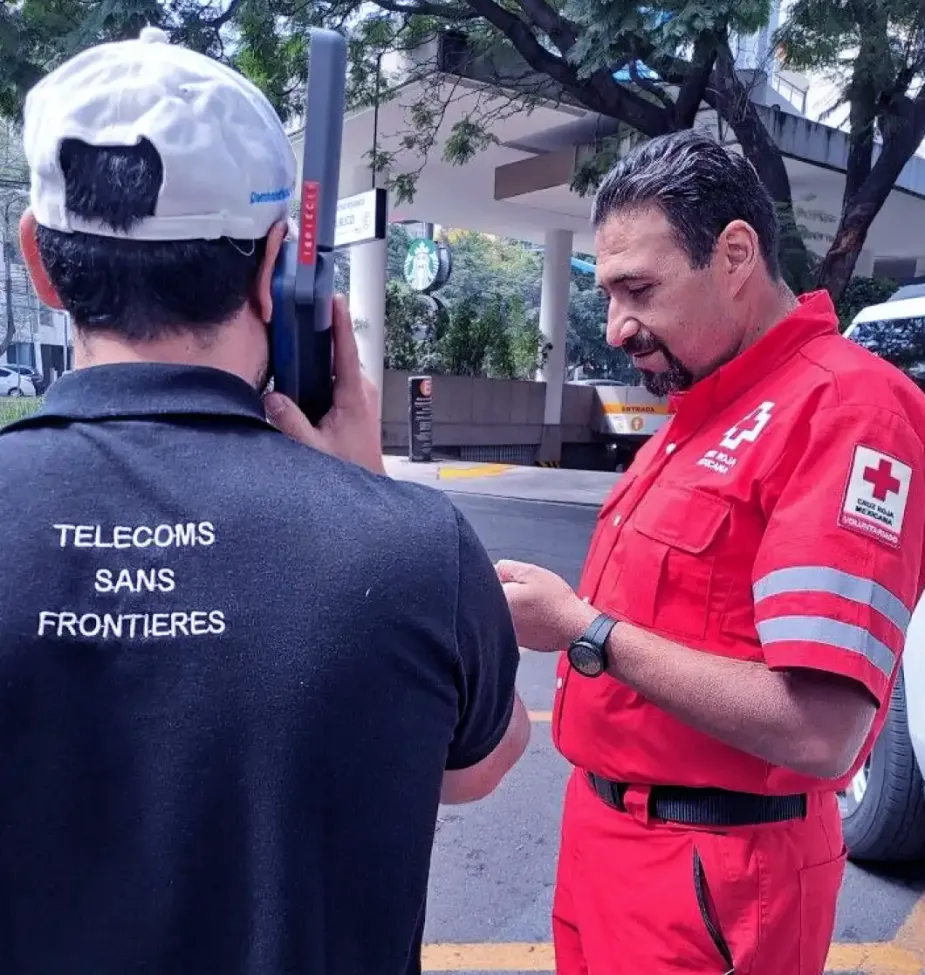
A humanitarian worker from the Red Cross speaks with a telecommunications technician outdoors

Satellite Connectivity for Disaster Relief

When Hurricane Melissa struck Jamaica in October 2025, the non-government organisation Télécoms Sans Frontières (TSF) partnered with Eutelsat to restore communications in the disaster zone. TSF specialises in emergency connectivity deployed to worst-affected areas, to help agencies save lives and reconnect families.

When disaster strikes, communications go down

In October 2025, Télécoms Sans Frontières (TSF) faced a catastrophic situation as Category 5 Hurricane Melissa made landfall in Jamaica and brought destruction to the island nation.

Within hours, terrestrial infrastructure that could have been used to enable emergency response operations had been torn apart by winds, floods and landslides. For the worst-affected communities, the ensuing silence became as dangerous as the storm itself.

TSF worked alongside Eutelsat partners including Neptune Communications to restore a connectivity lifeline needed for first responders to coordinate rescue efforts, access medical care and reconnect loved ones separated as a result of the storm. The operational requirements were clear: secure, reliable connectivity for command and control, voice and data services for field teams, and networks capable of sustaining continuous operations under austere conditions that met both humanitarian standards and government requirements.

The Challenge

When Hurricane Melissa struck, the widespread outage of ground infrastructure left thousands cut off from essential public services and emergency coordination. Approximately 120,000 homes were damaged or destroyed, with thousands displaced across the island and schools forced to close indefinitely.

Health officials faced the risk of disease outbreaks at evacuation centres; many field hospitals and clinics had no way to coordinate care or share patient data. Local businesses shut down, cutting off livelihoods and supply chains at a moment when their resilience mattered most.

Families separated during evacuation had no means to confirm safety or arrange reunification, compounding trauma and uncertainty. When natural disasters strike and terrestrial networks fail, communities lose their ability to call for help and coordinate relief operations.

Critical Need: Rapidly Deployable Satellite Connectivity

Emergency responders and humanitarian organisations on the island required satellite-based solutions that could be moved into position quickly and would operate independently of compromised terrestrial infrastructure. The operational requirements were clear:

  • Deployable network access: Connectivity for command and control, situational reporting and inter-agency coordination across multiple response teams
  • Broadband with low latency: Voice, video and data services for field operations, rapid decision-making and resource allocation in high-pressure environments
  • Network resilience: Robust service continuity in austere conditions to meet both humanitarian standards and government requirements
  • Procurement: Service design within public procurement frameworks; transparent cost structures, and responsible use of relief funds
  • Compliance and security: Services that adhere to data-protection regulations and secure handling of sensitive data (health, logistics, personal information)

For organisations like TSF, the challenge was to implement a communications backbone that would support life-saving operations from day one and through months of recovery.

The Solution: Rapidly Deployable Satellite Connectivity

Eutelsat delivered rapidly deployable satellite connectivity for exactly this scenario. Using VSAT terminals and GEO satellite internet services, response teams established broadband links to field hospitals, coordination centres and evacuation points within hours of the storm passing.

The satellite system provided:

  • Rapid installations: VSAT terminals were deployed at critical sites, enabling life-saving coordination and medical provision without waiting for terrestrial repairs
  • Secure voice and data channels: Encrypted satellite links supported humanitarian teams with the bandwidth needed for real-time collaboration, telemedicine consultations and logistics management
  • Connectivity for families to communicate and reunite: Public Wi-Fi zones allowed displaced residents to reach relatives, share vital information and begin the process of rebuilding

Eutelsat's GEO capability ensured coverage even in the most remote and damaged areas. The solution integrated seamlessly with existing emergency management workflows, providing disaster recovery and humanitarian assistance tailored to the operational realities of crisis zones.

Network resilience features, including redundant paths and priority access, guaranteed that critical services remained online throughout the emergency. For public sector leaders planning for resilience, Eutelsat's civil government satellite services offer proven procurement pathways, cybersecurity compliance and the operational flexibility required to meet strict regulatory and budgetary constraints.

As Jamaicans at home and abroad come together to rebuild and recover in the wake of Hurricane Melissa, the importance of dependable and resilient communication systems has never been clearer. At Neptune Communications, we remain steadfast, present, and at work to keep Jamaica #AlwaysOn during this challenging time.

Julian Jordan

CEO Neptune Communications


Impact: Lives Saved, Families Reunited

Satellite connectivity played a key role in Jamaica's relief operations, enabling coordinated response efforts that would have been impossible without resilient communications infrastructure.

With 1,500 unique devices accessing Wi-Fi and four coordination centres connected for TSF alone, aid teams coordinated rescue missions, medical triage and logistics without delay. Satellite links enabled real-time collaboration between emergency services, government agencies and international relief organisations, ensuring resources reached the most vulnerable communities.

Thousands of displaced residents reconnected with loved ones during the crisis, reducing uncertainty and supporting mental health in the immediate aftermath. TSF and partner agencies maintained uninterrupted communication throughout the emergency and into the recovery phase, demonstrating the strategic value of satellite internet as a backbone for disaster response.

Eutelsat's multi-orbit capabilities, combining GEO stability with the agility of its low-latency LEO satellite constellation, ensure that resilient connectivity remains available precisely when it is needed most. When terrestrial networks fail, satellite systems ensure that the flow of information, coordination and care continues uninterrupted.

Frequently Asked Questions

  • Portable satellite terminals, including VSAT systems, can be activated within hours of arrival on site, establishing broadband links without relying on damaged ground infrastructure. These terminals connect directly to geostationary (GEO) satellites positioned above the Earth, providing stable, wide-area coverage across remote and affected regions. In the Hurricane Melissa deployment, Télécoms Sans Frontières and Eutelsat partners established critical communications infrastructure immediately, enabling aid coordination and family reunification from day one. Pre-configured, plug-and-play terminals minimise setup time, whilst pre-approved procurement frameworks ensure regulatory compliance is maintained even under urgent conditions.

  • Satellites operate independently of ground infrastructure, so when floods, landslides or severe storms destroy fibre cables and mobile towers, satellite systems continue to function without interruption. Eutelsat's multi-orbit architecture can combine the stability and bandwidth of GEO satellites with the more low-latency agility of LEO constellations, delivering robust, redundant connectivity across all terrains. This independence from vulnerable terrestrial infrastructure ensures that satellite internet remains available precisely when it is needed most—during the critical hours and days following a disaster, enabling communication during disasters and maintaining the flow of information between response teams.

  • Disaster management can rely on both GEO and LEO satellites to deliver resilient connectivity in crisis zones. GEO satellites, positioned in geostationary orbit, provide stable, high-capacity broadband coverage over wide geographic areas, supporting coordination centres, field hospitals and command operations with continuous connectivity. LEO constellations, orbiting closer to Earth, deliver low-latency, high-speed links that enable real-time collaboration, situational reporting and rapid data exchange between agencies. Eutelsat's multi-orbit approach integrates both GEO and LEO capabilities, ensuring that disaster management teams maintain uninterrupted communication even when terrestrial networks are destroyed, with redundant paths and priority access for mission-critical operations.

  • Bandwidth can be scaled dynamically to serve coordination centres, field hospitals and evacuation points simultaneously, ensuring that multiple agencies and response teams maintain uninterrupted communication. In the Hurricane Melissa case study, the satellite system supported 1,500 unique devices and four coordination centres for TSF alone, demonstrating the capacity to handle large-scale, multi-site operations. This scalability is essential for complex relief efforts where humanitarian teams, government agencies and emergency services must collaborate in real time to deliver aid, coordinate rescue missions and restore public services across affected regions.

Connectivity Non-Governmental Organisation (NGO) Disaster recovery Climate event
Industry
Government
Eutelsat and Airtel back Indian Army relief in Sri Lanka
  • Partnering with Airtel and the Indian Army to support relief operations
  • Enabling critical communications and 24/7 telemedicine support in affected regions

New Delhi, 15thDecember 2025 - Eutelsat (ISIN: FR0010221234 - Euronext Paris / London Stock Exchange: ETL) together with its partner Airtel, is extending its OneWeb, Low Earth orbit (LEO) satellite connectivity to strengthen the Indian Army’s ongoing humanitarian relief operations in flood-impacted areas of Sri Lanka.

With the deployment of Eutelsat’s OneWeb high-speed, low latency LEO services, the Indian Army has been able to re-establish reliable communications in regions where terrestrial networks have been severely disrupted. The connectivity is facilitating 24/7 telemedicine consultations with specialist medical teams, ensuring the Army is able to deliver essential healthcare and emergency assistance to affected communities without delay. The initiative highlights the critical role of resilient, fast, satellite infrastructure in restoring essential services and in operational continuity during disaster response efforts.

Neha Idnani, Regional Vice President for APAC, Eutelsat, said: “Eutelsat is deeply committed to supporting the Indian Army’s relief efforts with OneWeb LEO connectivity, delivered in partnership with Airtel. The ability to maintain high-quality communications in crisis situations is vital, and we remain committed to equipping organisations on the ground with secure, resilient connectivity required to safeguard lives and enable essential services.”

Indian Army operates a field telemedicine centre powered by Eutelsat's OneWeb with Airtel.JPG 3422203 Photo : Indian Army operates a field telemedecine centre powered by Eutelsat’s OneWeb with Airtel
Industry
Government 0

Eutelsat together with its partner Airtel, is extending its OneWeb, Low Earth orbit (LEO) satellite connectivity to strengthen the Indian Army’s ongoing humanitarian relief operations in flood-impacted areas of Sri Lanka.

Mynewsdesk Source ID
3422203
Case study
Cheetowaga, NY State, USA
A paramedic loads a stretcher into the back of an ambulance at night, with emergency medical equipment visible inside.

Transforming Public Safety Communications Networks 

Traditional mobile networks often fail when they're needed most. Emergency teams in rural and off-grid areas face critical connectivity gaps that can hinder life-saving services. A reliable Public Service Broadband Network (PSBN) provides secure, always-on connectivity, helping public safety personnel and emergency responders reach every community.

Always-on connectivity when every second counts

The Challenge

Emergency teams operate where connectivity matters most—and where it often fails. Cellular networks designed for urban and suburban markets can leave vast rural areas underserved. Public safety radio networks too can face capacity and coverage limitations beyond certain boundaries. Without reliable high-speed connectivity, the risk levels for response teams and their operations at the scene of a critical incident are high. Any lack of secure communication can compromise coordination efforts to respond. Thinking to the future, a lack of connectivity can also compromise the arrival of new and emerging technologies designed to strengthen existing systems and emergency service.

  • Delayed decision-making: Without real-time data, teams cannot direct responses or treatment in the field
  • Operational risk: Coordination of effort is compromised during critical incidents
  • Resource inefficiency: People and patients may be transported to other centres unnecessarily, consuming time and capacity

Critical Needs: Standards and Requirements

Blue light service teams need solutions to deliver always-on communications in a zero-connectivity zone; where coverage, network access, interoperability and hardware are robust enough to resist disruption from different angles including: hostile actions, user and traffic congestion, geographic location, physical landscape, climate change and extreme weather. They need connectivity that can be:

  • mobile, vehicle-based and rapidly deployable
  • interoperable between radio and IP systems
  • scalable for sudden spikes in demand 
  • accessible beyond traditional coverage areas.

Our Solution: Mobile Satellite and Hybrid Connectivity

Eutelsat's local partnership in New York state, with IP Access and Dejero, is in service to deliver always-on, off-grid coverage using satellite and hybrid networking technology. Fire trucks, ambulances, and battalion chief rigs have been equipped with portable, transportable satellite antennas and the IP Access SuperGIG™ solution that combines satellite-backed connectivity with terrestrial networks for real-time mobile data exchange. The solution features Intellian OW10HV antennas working with Dejero 211 GateWays, and Eutelsat’s LEO coverage.

Key Features:

The Impact: Strengthening Emergency Management

“This isn’t just an upgrade—it’s a lifeline in the field.”​ One first responder shared that their call, which would normally drop mid-route, stayed connected the entire drive back to command centre. Emergency teams—including police, fire and medical services—can improve early diagnosis and treatments in situ, with access to support specialists with their skills and knowledge located elsewhere. 

  • Connected teams—police, fire and EMS services—can improve overall care and treatment 
  • Services at the scene can avoid unnecessary use of additional resources and reduce strain on limited public service budgets

Frequently asked questions

  • A public safety network is a communications network used by emergency services — including police, fire and emergency medical services — to coordinate during emergencies and day-to-day operations. These networks may also be called public safety wireless and radio networks. They support first responders and public safety personnel by enabling voice, data and video communications across agencies and jurisdictions. These networks are designed to be secure, reliable and interoperable, ensuring that responders can share critical information in real time, even when working across organisational boundaries.

  • A Public Safety Broadband Network (PSBN) provides secure, high-speed wireless data communications for emergency responders. The purpose of a PSBN is to enable first responders to access mission-critical applications, share real-time information and coordinate effectively during natural disasters, major incidents and routine operations. A PSBN also serves as an alternative emergency mobile network when commercial infrastructure is compromised. It ensures reliable connectivity with network prioritisation, guaranteeing that public safety users maintain uninterrupted access even when commercial networks are congested or unavailable.

  • Public safety networks typically operate across remote, rural and urban environments, serving law enforcement, fire services, emergency medical teams and other agencies responsible for community safety. These networks must function in diverse and challenging conditions—from densely populated city centres to isolated off-grid areas where terrestrial infrastructure is limited or non-existent. In this NY State case study, the network supports emergency vehicles and field teams across underserved rural regions, ensuring that responders maintain connectivity wherever they are deployed.

  • Regional public safety networks are planned and designed to address local coverage gaps, integrate with broader communications infrastructure and meet the specific operational needs of the communities they serve. Planning involves assessing geographic challenges, identifying areas where terrestrial networks are insufficient and coordinating with local agencies to ensure interoperability and compliance with cybersecurity standards. Design considerations include selecting appropriate technologies—such as satellite backhaul for resilience—and establishing governance frameworks that enable rapid deployment and scalable capacity during emergencies.

  • Satellite connectivity strengthens public safety networks by providing resilient, always-on communications that remain operational when terrestrial infrastructure fails or is unavailable. By augmenting public safety wireless and radio networks with satellite backhaul, agencies ensure resilient coverage across all operating environments. In this case study, the integration of satellite technology with hybrid networking ensures that emergency teams maintain secure, high-capacity links for voice, video and data—even in the most remote or disaster-affected areas. Satellite solutions deliver rapid deployment, redundancy and seamless integration with existing systems, enabling responders to access critical information and coordinate effectively under any conditions. For more on how multi-orbit architectures enhance operational continuity, explore our page on network resilience. Additional resources and case studies are available through the Eutelsat media centre.

Connectivity Blue lights Ambulance Emergency vehicles Remote areas Satellite connectivity
Industry
Government
Photo of a solder using laptop and radio

Secure DEFENCE Connectivity for mission critical operations

SUPPORT YOU CAN TRUST

In the chaos of modern warfare, there is essentially no room for vulnerability; every moment calls for strength and resilience.

One of the most vital assets in such environments is dependable satellite connectivity, which guarantees continuous communication, situational awareness, and coordinated operations, even in the most challenging conditions. Satellite connectivity plays an essential role in:

  • Guaranteeing seamless communication wherever and whenever it is most needed, to provide vital information superiority.
  • Facilitating operational agility through reconfigurable SATCOM systems and more agile Command and Control (C2).
  • Strengthening the existing SATCOM heritage infrastructure with commercial solutions to support the armed forces' increasingly data-hungry applications.
  • Supporting Morale, Welfare and Recreation initiatives to enhance the well-being and quality of life of military personnel during their deployments.
Photo of an aircraft carrier

SATELLITE CONNECTIVITY FOR MISSION-CRITICAL OPERATIONS

Eutelsat provides secure, resilient, and low-latency satellite connectivity, essential for the armed forces' digital transformation, to enhance communication, real-time data sharing, and operational efficiency in key domains - land, sea, air.

Trusted partner

With over 40 years of experience, a certified global network of partners, and a commitment to vigilant corporate governance, along with strong SLAs, we aim to be your most trusted partner.

Seamless integration

Interoperable solutions that are easy to integrate into existing and future infrastructures, combined with a broad range of User Terminals, adapted to harsh environments.

Low-latency

Eutelsat's OneWeb low-Earth orbit constellation provides low-latency communication for real-time applications.

Total control

Innovative digital products that give you full control over your SATCOM services including Satellite Virtual Network Operator (SVNO).

Resiliency

GEO, LEO or multi-orbit solutions, combined with advanced ground infrastructures, enable us to provide mission assurance with dynamic
service provisioning and backup.

Solutions for U.S. Government and Defense

Eutelsat Network Solutions delivers purpose-built connectivity solutions for the U.S. government and DOW.

For connectivity for United States government and DOW users, Eutelsat Network Solutions, the independent proxy company and U.S. subsidiary of Eutelsat, provides resilient, reliable solutions via our global GEO fleet and OneWeb LEO constellation. Visit the EutelsatNS website to learn more and contact the team.

Photo of a plane that flies through the sky

Ready to connect?

Photo of first responders in their car communicating through radio

DEPENDABLE CONNECTIVITY FOR SECURITY

KEEP THE SITUATION UNDER CONTROL

Blue light forces and first responders require reliable connectivity when deployed at short notice. Satellite connectivity can provide maximum bandwidth with minimal latency across all locations, enhancing citizen protection and enabling operations.

  • Facilitating timely coordination between deployed forces on the ground and headquarters or rescue units.
  • Allowing rapid voice and data communications within a multi-domain operating environment, even on the move.
  • Ensuring real-time Command and Control (C2) and shorten decision-making cycles by providing the most relevant, up-to-date situational awareness.
  • Supporting observation, surveillance and reconnaissance missions remotely, with technologies requiring low-latency, for early threat detection.
Photo of rescue workers in the UK

SATELLITE CONNECTIVITY FOR SECURITY APPLICATIONS

Eutelsat provides Primary, Alternate, Contingency, and Emergency (PACE) communications to ensure mission-critical connectivity wherever and whenever it is needed most.

Global coverage

High-capacity connectivity in areas where communications infrastructure and cellular network coverage are unavailable or nonexistent.

Flexible

Scalable solutions with guaranteed quality of service through SLA and Commited Information Rate (CIR).

Secure

End-to-end security by design encompassing space, ground, and user segments.

Resilient

GEO, LEO or multi-orbit solutions to ensure maximum levels in security and redundancy.

Versatile

A wide range of User Terminals adapted to fast deployment, comms on the move and comms on the pause in contested environments.

Ready to connect?

Photo of a corporate employee using her laptop

SECURE CONNECTIVITY FOR CIVIL GOVERNMENT

SECURE YOUR CRITICAL INFRASTRUCTURE

Connecting critical infrastructures, government agencies and emergency services is essential for smooth daily operations. Secure, robust SATCOMs play a key role in maintaining national interests and safeguarding citizens during crises or when terrestrial networks are compromised or unavailable:

  • Ensuring rapid resource deployment and real-time coordination and information-sharing to government bodies and emergency services.
  • Facilitating data collection and transmission for weather forecasting and climate monitoring with Earth Observation.
  • Enhancing emergency response while ensuring continuity of essential services through a redundant, multi-orbit offering.
  • Bridging the digital divide by delivering internet access to schools, hospitals and rural communities in underserved areas.
Photo of a front facade of a civil government building

SATELLITE CONNECTIVITY FOR CIVIL GOVERNMENT APPLICATIONS

Eutelsat provides secure, reliable, low-latency satellite connectivity that enhances civil government operations, decision-making and emergency response globally.

Cyber & GPS resilience

Secure solutions from anti-jamming to cyphering for
protected communication services.

Assured service

Reliable solutions with guaranteed quality of service through SLA and Commited Information Rate (CIR).

Low electronic signature

Using different beams and frequencies every 11 seconds and switch satellite every 2.5 minutes.

24/7 support

A global network of distribution partners offering round-the-clock customer support to quickly and effectively resolve any connectivity issues.

Robustness

GEO, LEO, multi-orbit and multi-band solutions for outstanding security, performance and redundancy, even in the most challenging environments.

Ready to connect?

Photo of a rescue helicopter

SECURE CONNECTIVITY FOR CRISIS MANAGEMENT

A LIFELINE FOR EMERGENCIES

Given the rising frequency of both natural and man-made disasters, regions across the globe are increasingly vulnerable to emergencies and humanitarian crises.

Effective, rapid response is crucial to saving lives, minimising damage and providing essential services, such as:

  • Strengthening multi-domain operations through a secure and resilient multi-orbit infrastructure.
  • Ensuring real-time Command and Control (C2) and effective decision-making, via continuous communication links.
  • Transmitting large amounts of data to enhance coordination among emergency, government and humanitarian services.
  • Maintaining high capacity from strategic to tactical levels through ground segments, low latency and global coverage.
Aerial photo of a flooded river

SATELLITE CONNECTIVITY FOR DISASTER RECOVERY AND HUMANITARIAN RESPONSE

Eutelsat offers best-in-class, multi-orbit, multi-mission satellite capacity to first responders, humanitarian organisations, and government agencies, providing support in disaster-affected areas in a joint operating environment.

Reliable

GEO, LEO, multi-orbit, and multi-band solutions for high performance, redundancy, and safety.

Global coverage

Multi-regional satellite connectivity solutions, ithat include Africa, the Middle-East and the Atlantic zone.

Multiclass terminals

A wide range of user terminals certified for use in harsh environments that can be quickly activated and deployed in emergency scenarios.

Tailored

Services tailored to adapt and adjust to the latency, throughput and level of security you need.

Worldwide gov partners

A global network of partners providing 24/7 technical support to resolve any issues quickly and efficiently.

Ready to connect?

Photo of soldiers using a laptop

GOVERNMENT

Global satellite connectivity powers governments with secure communication, real-time awareness, and resilient operations.

GAIN AN EDGE IN CRITICAL OPERATIONS

Governments must integrate their most critical missions with secure, resilient commercial satellite communication solutions that not only complement their existing satellite infrastructure but also provide flexible, scalable connectivity.

This integration is essential to ensure strategic independence for situational awareness, along with:

  • Delivering information superiority with dependable, low-latency connectivity that enables enhanced operational readiness and better-informed tactical decisions.
  • Improving operational agility through innovative digital tools that provide greater control over SATCOM capabilities.
  • Providing fully interoperable services for seamless integration into any existing or future defence systems.
  • Reinforcing emergency response while also maintaining the continuity of essential services, supporting disaster recovery, and strengthening overall national security.
Photo of a reaper pilot

SATELLITE CONNECTIVITY FOR GOVERNMENT APPLICATIONS

Eutelsat provides Secure, Assured, Resilient and Agile connectivity in geostationary and low-Earth orbits, to support governments and international agencies with reliable, trusted communication solutions.

Resilient

GEO, LEO or multi-orbit solutions for exceptional performance, redundancy and safety.

Flexible

Scalable service plans and flexible capabilities, tailored to accommodate evolving operational needs.

Agile

Innovative tools to plan your operations and monitor services via API and dedicated portals.

Versatile

A comprehensive range of user terminals that are easy to use and deploy, specifically adapted for on-the-move and on-the-pause communications.

Cyber-resistant

End-to-end security by design encompassing space, ground, and user segments.

Photo of media employees at their computer

BUILDING TRUST WITH EXPERIENCE

Eutelsat is the only fully integrated GEO-LEO satellite service provider in Europe, benefitting from more than 40 years of experience in the SATCOM industry.

Eutelsat offers controlled access to a trusted ecosystem. This includes world-class telecommunications partners, satellite operators and internet solution providers able to develop a resilient and affordable range of products and services. Working closely with system integrators, we guarantee secure and seamless services leveraging all our stakeholders. Moreover, a variety of short, mid and long-term leases gives you contractual flexibility with tailored conditions to adapt to any government and international agency need.


USEFUL RESOURCES

To find out more about our government connectivity services and availability around the world, consult these additional resources.

Case Study

 Fire service response vehicle with satellite communication equipment.
Emergency services Fire services LEO satellite network

LEO Connectivity for Fire & Emergency Services in France

When fire brigades respond to critical incidents, secure and uninterrupted communications are vital. Reliability is mission-critical when terrestrial networks fail in remote or disaster zones. This case study explores how LEO-powered satellite connectivity provides resilient, rapidly deployable links, enabling emergency services to maintain command and control during high-stakes operations.

A humanitarian worker from the Red Cross speaks with a telecommunications technician outdoors
Connectivity Non-Governmental Organisation (NGO) Disaster recovery

Satellite Connectivity for Disaster Relief

When Hurricane Melissa struck Jamaica in October 2025, the non-government organisation Télécoms Sans Frontières (TSF) partnered with Eutelsat to restore communications in the disaster zone. TSF specialises in emergency connectivity deployed to worst-affected areas, to help agencies save lives and reconnect families.

A paramedic loads a stretcher into the back of an ambulance at night, with emergency medical equipment visible inside.
Connectivity Blue lights Ambulance

Transforming Public Safety Communications Networks 

Traditional mobile networks often fail when they're needed most. Emergency teams in rural and off-grid areas face critical connectivity gaps that can hinder life-saving services. A reliable Public Service Broadband Network (PSBN) provides secure, always-on connectivity, helping public safety personnel and emergency responders reach every community.

Interested in securing your connectivity?

Eutelsat and Nelco sign LEO connectivity deal for India
  • Nelco to offer Eutelsat’s LEO connectivity for land, maritime, and aviation markets, supporting critical government and enterprise applications
  • Expanding the reach of Eutelsat’s LEO services across India’s borders, territorial waters, and remote regions

Paris, 11 August 2025 - Eutelsat (ISIN: FR0010221234 - Euronext Paris / London Stock Exchange: ETL) and Nelco Limited (ISIN: INE045B01015 – Listed on the equity segment of BSE Limited & National Stock Exchange of India Limited’s stock exchanges), a Tata Group company and one of India’s leading satellite communication service providers, have signed an agreement to deliver OneWeb low Earth orbit (LEO) satellite connectivity services across the India region.

Under the agreement, OneWeb India Communications, Eutelsat’s local operating entity, will partner with Nelco to deliver secure, low-latency LEO connectivity for customers on land, at sea, and in the air. Service coverage will extend across India’s borders, territorial waters, and remote regions, supporting a wide range of secure government and enterprise applications. These capabilities will strengthen India’s digital infrastructure and national security, while ensuring reliable connectivity in underserved areas. Nelco is well geared to offer these services to its customers as soon the OneWeb LEO services become commercially operational in the country.

Neha Idnani, Regional Vice President for APAC, Eutelsat and Director of OneWeb Communications India commented: "We are proud to partner with Nelco, part of the respected TATA Group, to deliver advanced LEO connectivity services in India. This agreement strengthens our strategic footprint in one of the world’s most dynamic and fast-growing connectivity markets and underscores our commitment to supporting India’s digital and security ambitions."

P J Nath, Managing Director and Chief Executive Officer of Nelco, commented: "We are pleased to partner with Eutelsat to bring OneWeb LEO satellite connectivity services to India. This partnership marks a significant step in enabling reliable, secure, and high-speed communication solutions based on LEO services for critical sectors across land, sea, and air. It reflects our strategy to provide comprehensive multi-orbit satellite connectivity services for advancing India’s digital ecosystem and supporting the country's strategic communication needs."

IMAGE_Press_Submarine-pipeline-laying-barge-during-sunset_GettyImages-1503702015_110825.jpg 3398819 India, Nelco connectivity deal © GettyImages
Industry
Government Enterprise Aviation Maritime Telecom 0

Eutelsat and Nelco Limited a Tata Group company and one of India’s leading satellite communication service providers have signed an agreement to deliver OneWeb low Earth orbit (LEO) satellite connectivity services across the India region.

Mynewsdesk Source ID
3398819
Subscribe to Government